
HD1910M vs XL330: Servo Comparison for MicroDuck
· Samet Durmaz
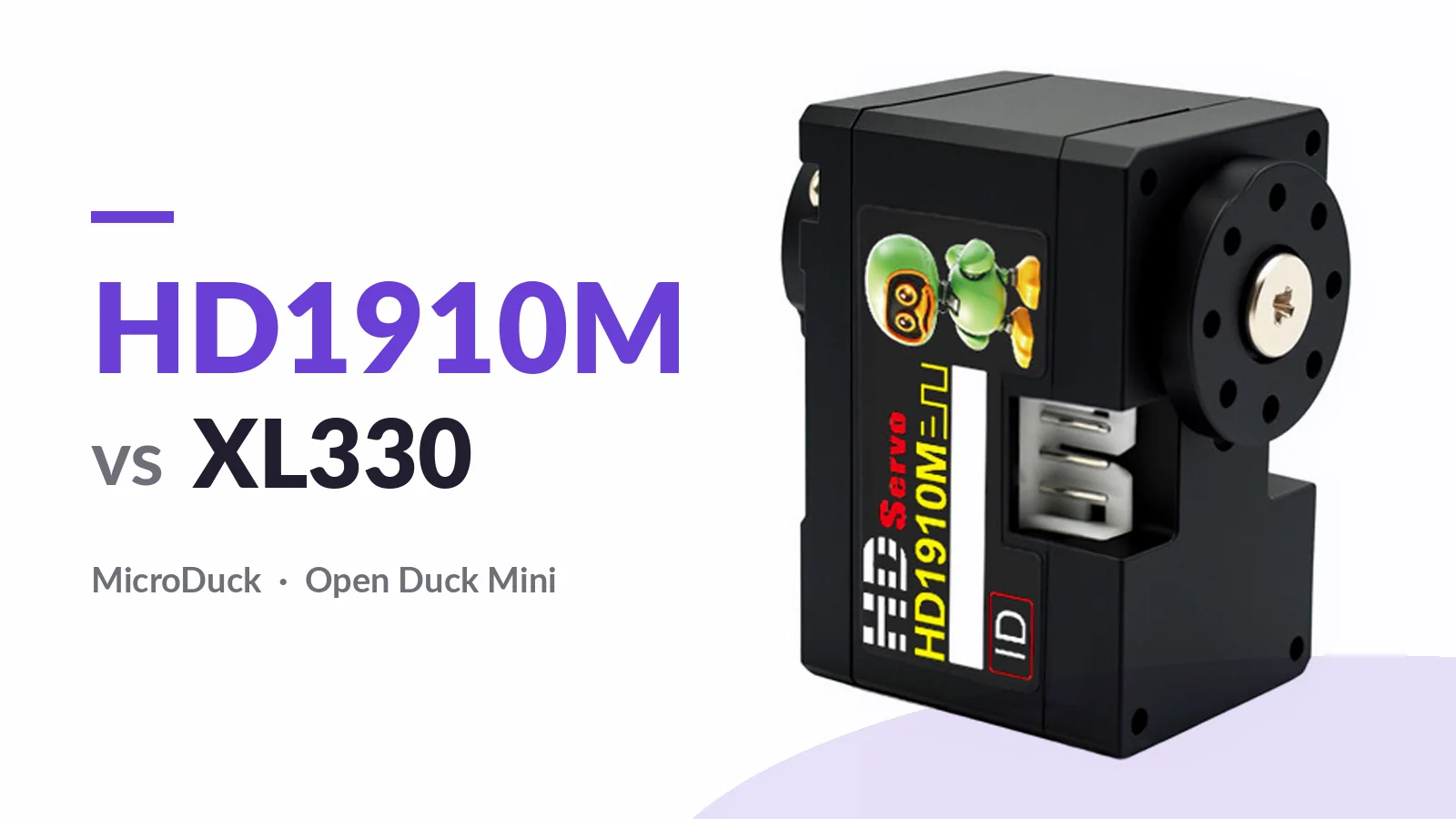
If you've decided to build a small bipedal robot like MicroDuck or Open Duck Mini, the servos are the most critical part of your bill of materials. How well the robot balances, how smoothly it walks and how well its joints survive falls all depend largely on the servos you choose.
The original Open Duck Mini design uses ROBOTIS's Dynamixel XL330-M288-T. Feetech developed the HD1910M in the same size class for this family of robots. In this article we compare the two servos using manufacturer data, at the same voltage and in the same units wherever possible.
Note: Robustonics sells the HD1910M. That's why every figure in this article comes from manufacturer sources or our own tests; you'll find the sources at the end.
Short answer
In the same size class, the HD1910M offers more than twice the stall torque of the XL330, metal gears and a wide voltage range up to 8.4 V. It fits directly in place of the XL330; on the software side, only the servo driver code needs to be switched to the Feetech protocol.
Comparison table
| Specification | Feetech HD1910M | Dynamixel XL330-M288-T |
|---|---|---|
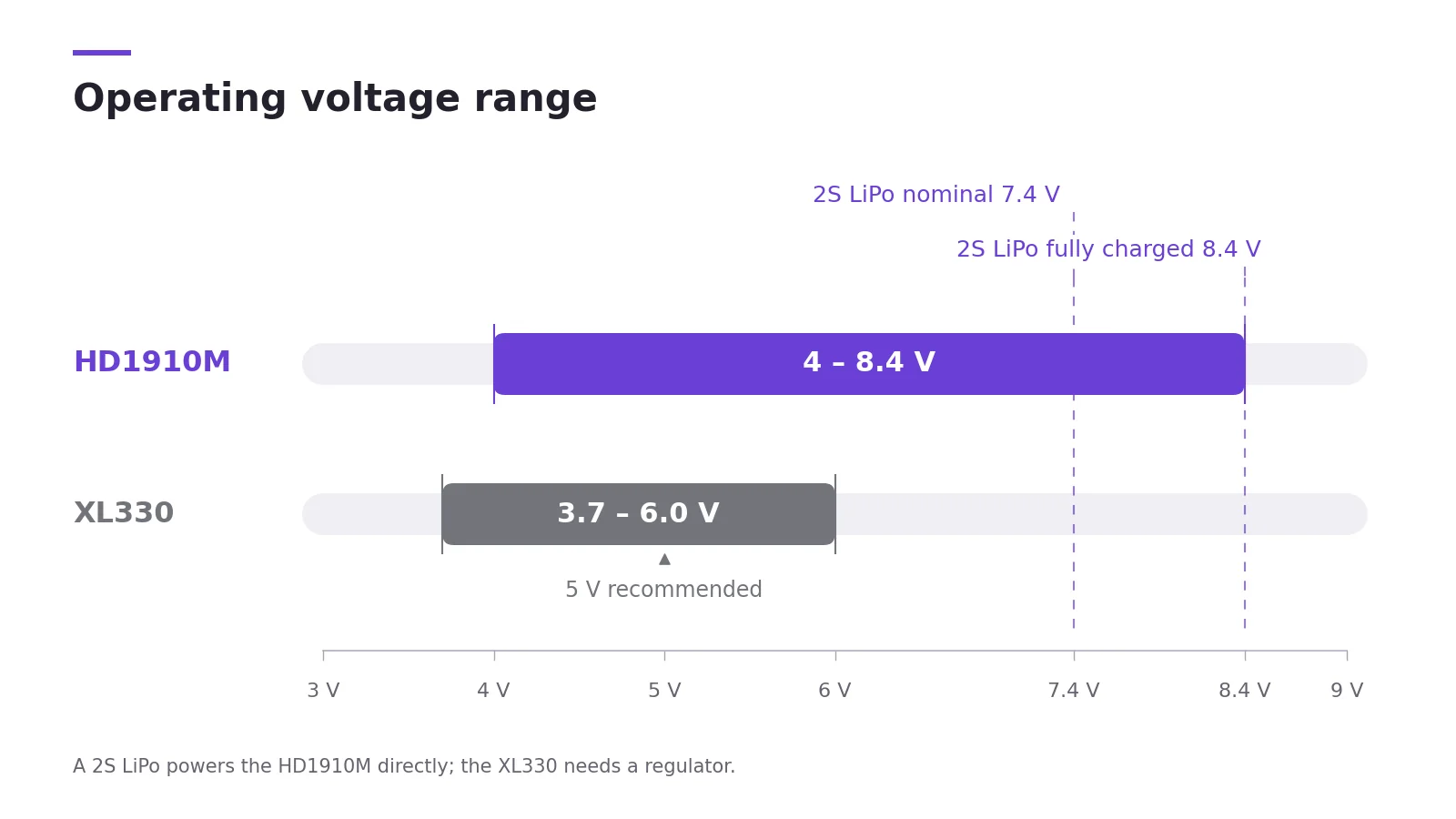
| Operating voltage | 4 – 8.4 V | 3.7 – 6.0 V (5 V recommended) |
| Stall torque | 9 kg·cm @4.8 V 12 kg·cm @6 V 15 kg·cm @7.4 V | ≈5.3 kg·cm (0.52 N·m) @5 V |
| No-load speed | 72 RPM @4.8 V 92 RPM @6 V 113 RPM @7.4 V | 103 RPM @5 V |
| Stall current | 1.2 A @4.8 V · 1.6 A @6 V · 2 A @7.4 V | 1.47 A @5 V |
| Motor | Coreless | Cored |
| Gears | Metal | Engineering plastic |
| Housing | PA66 + 43% glass fiber | Engineering plastic |
| Encoder | 360° magnetic | Contactless absolute, 12-bit (4096 steps/rev) |
| Communication | TTL serial bus, Feetech protocol | TTL multidrop bus, Dynamixel Protocol 2.0 |
| Dimensions | 34 × 20 × 23 mm | 34 × 20 × 26 mm |
| Weight | 21 ± 2 g | 18 g |
Torque and voltage: comparing like with like
The two manufacturers rate torque at different voltages, so putting the highest numbers in the table side by side would be misleading. Since the XL330 runs at no more than 6 V, a fair comparison has to be made in the 5–6 V range:
- At 6 V the HD1910M delivers 12 kg·cm of stall torque, about 2.3 times the XL330's rating at 5 V (≈5.3 kg·cm).
- At 4.8 V, slightly below the XL330's recommended voltage, the HD1910M is still about 1.7 times ahead with 9 kg·cm.
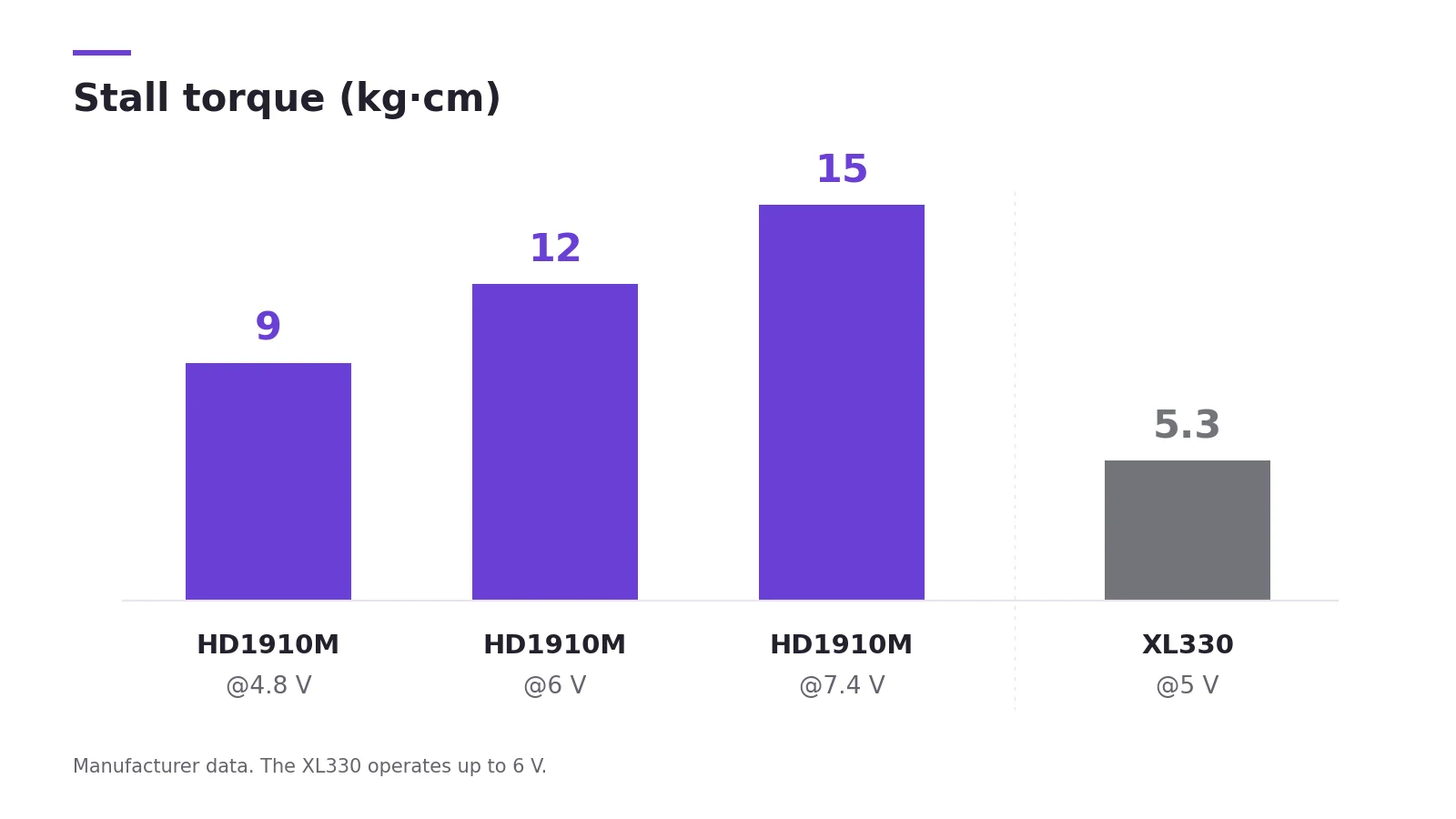
These figures are stall torque: the torque at the point where the servo can no longer turn. The torque you can safely use in continuous operation is lower; Feetech rates the HD1910M's nominal torque at 3.0 kg·cm at 6 V. In a bipedal robot, stall torque matters most while the robot is standing and when it recovers from a near-fall.
The voltage range also makes a practical difference. The HD1910M's 4–8.4 V range lets you run it directly from a 2S LiPo battery, which reaches 8.4 V when fully charged. With the XL330, a 2S battery needs a step-down regulator in between.
More torque means more current: the HD1910M can draw a stall current of 1.6 A at 6 V, the XL330 1.47 A at 5 V. When choosing a power supply or battery, allow for all servos being loaded at the same time.
At no load, the HD1910M runs at 72 RPM at 4.8 V, 92 RPM at 6 V and 113 RPM at 7.4 V; the XL330 is rated at 103 RPM at 5 V. Because the HD1910M's speed and torque both rise with voltage, it delivers its best performance from a 2S LiPo at around 7.4 V.
Durability: metal gears and a coreless motor
Bipedal robots fall, and every fall puts a sudden shock load on the joints. The HD1910M's metal gears withstand these shocks better than the XL330's engineering-plastic gears. Its housing is also made of glass-fiber reinforced PA66.
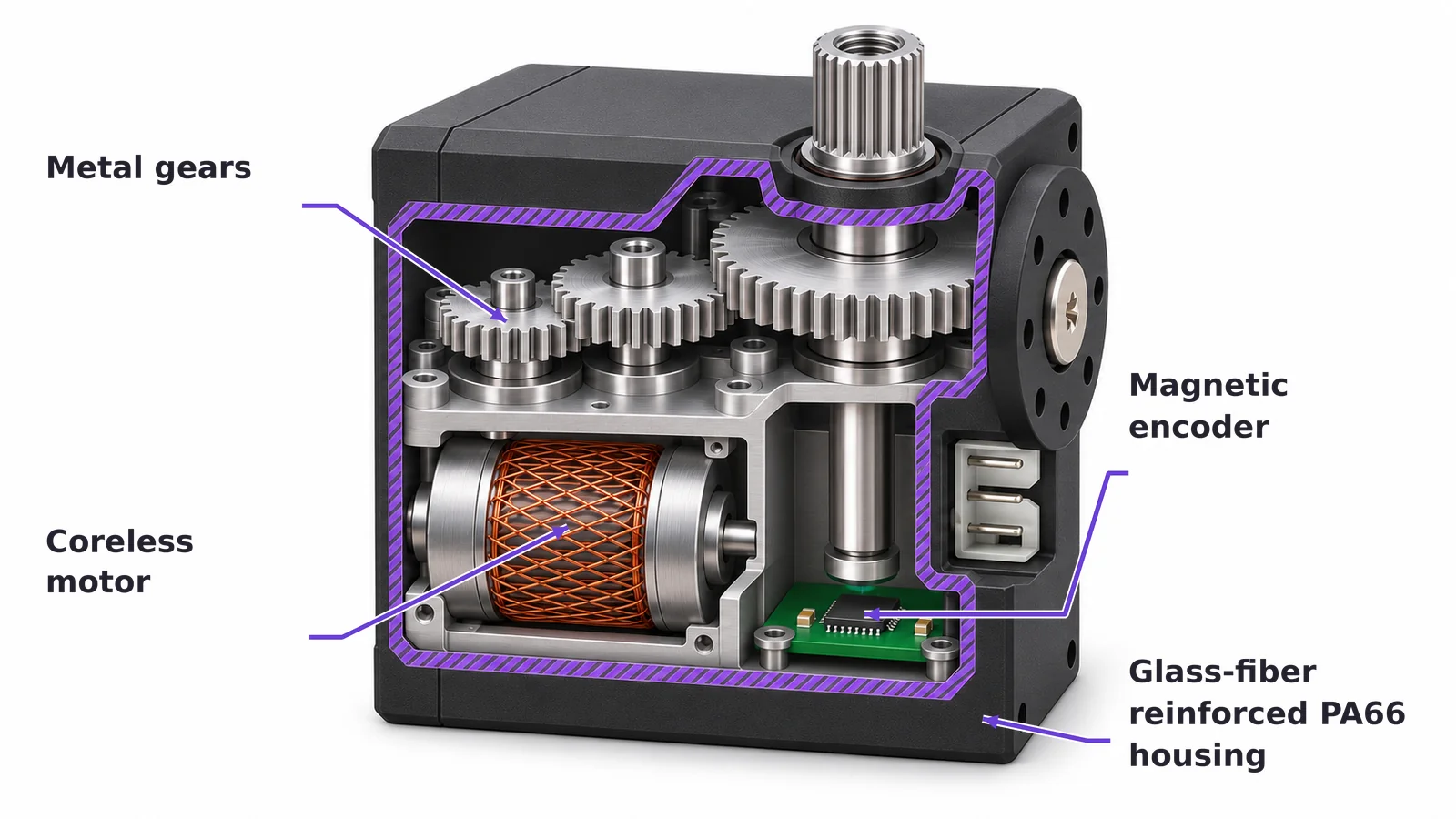
Illustrative drawing
The rotor of the HD1910M's coreless motor carries no iron core, so it is light; this makes it easier for the motor to speed up and slow down, and it responds faster. A servo that reacts quickly to commands helps with balance control.
The price of this robustness is weight: the HD1910M is about 3 g heavier than the XL330 (21 g vs 18 g). In a robot with many servos the difference adds up, but the HD1910M's extra torque easily covers the added weight.
Software and protocol: code doesn't carry over as-is
Both are TTL serial bus servos that daisy-chain on a single line, each with its own ID. However, they don't speak the same protocol: code and SDKs written for Dynamixel won't work directly with the HD1910M. Driving the HD1910M requires a library that supports Feetech's protocol.
The XL330 communicates using Dynamixel Protocol 2.0. Since the original Open Duck Mini software was written for this protocol, the part that talks to the servos has to be changed when you build the project with the HD1910M.
On the HD1910M side, you adapt the servo driver code to the Feetech protocol. To connect the servo to a computer you use an interface that supports the TTL serial bus (for example a Feetech URT-series USB programmer or a suitable driver board).
Mechanical fit
The two servos share the same footprint (34 × 20 mm); the HD1910M is 3 mm shorter (23 mm vs 26 mm). In robots designed for the XL330, the HD1910M fits directly in place of the XL330.
What does simulation show?
In a simulation with models of both servos in the open-source microduck-virtual-lab project, the XL330 model fell over in the standing test with a controller gain (P) of 200, while the HD1910 model stayed upright at a gain as low as P=5. In the walking test, the HD1910 model walked straight once heading control was added.
Keep in mind that this is a computer simulation, not a test with real servos. On a real robot, results will vary with the mechanical design, weight and software tuning.
Conclusion
The HD1910M is designed around the key needs of small bipedal robots like MicroDuck:
- Torque headroom: 12 kg·cm at 6 V, about 2.3 times the stall torque in the same size class,
- Durability: metal gears and a glass-fiber reinforced housing to survive falls,
- Fast response: a coreless motor,
- Flexible power: a 4–8.4 V range that runs from a 2S LiPo without a regulator.
In a robot designed for the XL330, you can mount the HD1910M directly in the same place. The only adaptation is on the software side: switching the servo driver code to the Feetech protocol. The robot's walking and balance logic can stay the same.
Watch the video
XGO-Duck, one of the open-source duck robot projects that use this servo family:
Feetech HD1910M
12 kg·cm torque at 6 V, metal gears, coreless motor, 21 g. For MicroDuck and similar bipedal robots.
View productFrequently asked questions
Is the HD1910M a drop-in replacement for the XL330?
Yes. Because the footprint is the same, the HD1910M fits directly into robots designed for the XL330. On the software side, the servo driver code needs to be adapted to the Feetech protocol.
Do both servos run from the same power supply?
Both work in the 5–6 V range. The XL330's upper limit is 6 V, while the HD1910M goes up to 8.4 V. A 2S LiPo battery can power the HD1910M directly; the XL330 needs a regulator.
Does the HD1910M work with a standard RC receiver or PWM signal?
No. The HD1910M is a serial bus servo; it needs a driver board or USB programmer that supports the TTL serial bus.
Will my Dynamixel code work with the HD1910M?
Not directly. The two servos use different protocols; you need to replace the part of your code that talks to the servos with a Feetech library. The robot's motion logic (walking, balance) can stay the same.
Sources
- ROBOTIS e-Manual: XL330-M288-T
- Feetech HD1910M (HD-1910-C001) manufacturer specification sheet
- microduck-virtual-lab (simulation)
This guide is also available in Turkish (Türkçe).